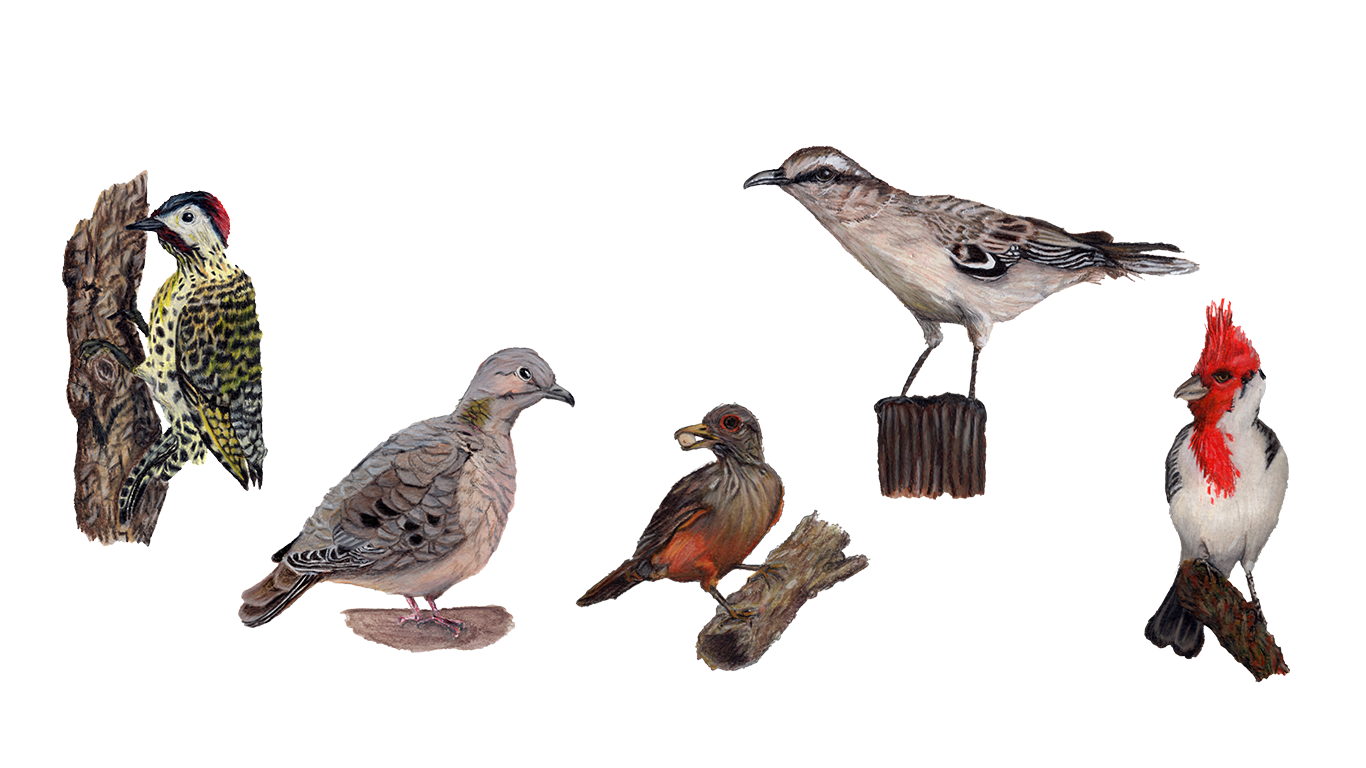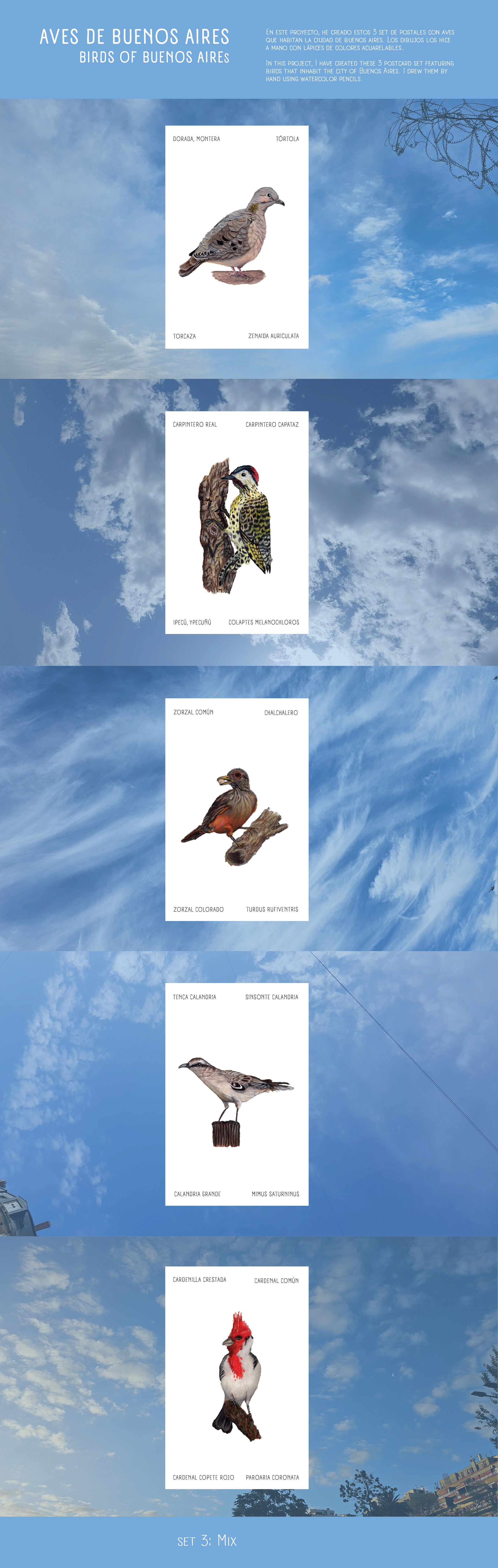
nombre científico: Mimus saturninus
nombre común: Calandria Grande, Calandria Común, Tenca Calandria, Cenzontle de cejas blancas, Sinsonte calandria.
tamaño: 25 cm - hábitat: ampliamente distribuida en América del Sur.
datos curiosos:
~ puede comer huevos o pequeños vertebrados como lagartijas o culebras.
~ control de insectos, dispersión de semillas.
~ su canto es agradable y muy variado, incluso puede imitar sonidos.
~ puede comer huevos o pequeños vertebrados como lagartijas o culebras.
~ control de insectos, dispersión de semillas.
~ su canto es agradable y muy variado, incluso puede imitar sonidos.
nombre científico: Paroaria Coronata
nombre común: Cardenal Copete Rojo, Cardenilla Crestada, Cardenal Común, Cardenal.
tamaño: 17 cm - hábitat: parte norte y central de Sudamérica.
datos curiosos:
~ se alimenta de semillas y frutos. A veces puede comer insectos.
~ nido en copa en arbustos.
~ pone 3 huevos de color blancuzco verdoso con pintas pardas o lilas.
~ canto melodioso
~ se alimenta de semillas y frutos. A veces puede comer insectos.
~ nido en copa en arbustos.
~ pone 3 huevos de color blancuzco verdoso con pintas pardas o lilas.
~ canto melodioso
nombre científico: Colaptes melanochloros
nombre común: Carpintero capataz. Carpintero copete rojo, Carpintero de pecho manchado. Carpintero nuca roja, Carpintero real, Carpintero rojo, Ipecú, Pájaro carpintero, Pájaro pico, Ypecuñú y otros.
tamaño: 23 cm - hábitat: centro y centro-sur de América del Sur.
datos curiosos:
~ los incuban entre ambos padres.
~ picotean árboles para alimentarse y comunicarse.
~ controlador de insectos.
~ el macho presenta una banda roja en la cara a la altura del pico.
~ los incuban entre ambos padres.
~ picotean árboles para alimentarse y comunicarse.
~ controlador de insectos.
~ el macho presenta una banda roja en la cara a la altura del pico.
nombre científico: Zenaida Auriculata
nombre común: Torcaza, Dorada, Montera, Tórtola.
tamaño: 22 cm - hábitat: vive comúnmente en Sudamérica. Se las puede ver en parques, plazas y jardines. Esta especie, en algunos lugares y debido a la abundancia de alimento, ha aumentado su población en forma desmedida.
datos curiosos:
~ no hay diferencias entre macho y hembra.
~ ambos padres cuidan de los pichones.
~ su canto anuncia que “La Solapa” viene bajando la loma (ser mitológico del litoral argentino).
~ no hay diferencias entre macho y hembra.
~ ambos padres cuidan de los pichones.
~ su canto anuncia que “La Solapa” viene bajando la loma (ser mitológico del litoral argentino).
nombre científico: Turdus Rufiventris
nombre común: Zorzal Colorado, Zorzal Común (en Uruguay) o Chalchalero (norte de Argentina).
tamaño: 23 cm - hábitat: en el oeste de Bolivia, Paraguay y Uruguay, sur de Brasil y en el centro y litoral de la Argentina.
datos curiosos:
~ suelen llevar las alas algo caídas.
~ al detenerse balancea la cola de arriba hacia abajo.
~ los machos de adultos tienen el pico y el periocular de color amarillo muy fuerte.
~ los huevos son de color celeste con pintas marrones.
~ suelen llevar las alas algo caídas.
~ al detenerse balancea la cola de arriba hacia abajo.
~ los machos de adultos tienen el pico y el periocular de color amarillo muy fuerte.
~ los huevos son de color celeste con pintas marrones.
scientific name: Mimus saturninus
common name: Chalk-browed Mockingbird, Great Lark, Common Lark, Lark Tench, White-browed Mockingbird, Lark Mockingbird.
size: 25 cm - habitat: widely distributed in South America.
interesting facts:
~ can eat eggs or small vertebrates such as lizards or snakes.
~ insect control, seed dispersal.
~ its song is pleasant and highly varied, it can even mimic sounds.
~ can eat eggs or small vertebrates such as lizards or snakes.
~ insect control, seed dispersal.
~ its song is pleasant and highly varied, it can even mimic sounds.
scientific name: Paroaria coronata
common name: Red-crested Cardinal, Crested Cardinal, Common Cardinal, Cardinal.
size: 17 cm - habitat: northern and central parts of South America.
interesting facts:
~ feeds on seeds and fruits. Sometimes it may eat insects.
~ cup nest in bushes.
~ lays 3 eggs of greenish-white color with brown or lilac spots.
~ melodious song.
~ feeds on seeds and fruits. Sometimes it may eat insects.
~ cup nest in bushes.
~ lays 3 eggs of greenish-white color with brown or lilac spots.
~ melodious song.
Scientific name: Colaptes melanochloros
Common name: Green-barred Woodpecker. Foreman carpenter. Spot-breasted Woodpecker. Red-naped Woodpecker, Royal Woodpecker, Red-naped Woodpecker, Ipecú, Woodpecker bird, pico bird, Ypecuñú and others.
Size: 23 cm - Habitat: central and south-central South America.
interesting facts:
~ they are incubated by both parents.
~ they peck trees to feed and communicate.
~ insect controller.
~ the male has a red band on the face at the level of the beak.
~ they are incubated by both parents.
~ they peck trees to feed and communicate.
~ insect controller.
~ the male has a red band on the face at the level of the beak.
scientific name: Zenaida auriculata
common name: Eared Dove. Torcaza, Dorada, Montera, Tórtola.
size: 22 cm - habitat: commonly found in South America. They can be seen in parks, squares, and gardens. In some places and due to the abundance of food, this species has seen its population increase disproportionately.
interesting facts:
~ there are no differences between males and females.
~ both parents care for the chicks.
~ its song announces that "La Solapa" is coming down the hill (mythological being from the Argentine coast).
~ there are no differences between males and females.
~ both parents care for the chicks.
~ its song announces that "La Solapa" is coming down the hill (mythological being from the Argentine coast).
scientific name: surdus rufiventris
common name: Rufous-bellied Thrush. Red Thrush, Song Thrush, Zorzal Común (Uruguay) or Chalchalero (north Argentina).
size: 23 cm - habitat: in western Bolivia, Paraguay, and Uruguay, southern Brazil, and in the center and coastal regions of Argentina.
Interesting facts:
~ they often carry their wings slightly drooped.
~ when perched, they sway their tail up and down.
~ adult males have a very strong yellow bill and periocular area.
~ eggs are sky blue with brown speckles.
~ they often carry their wings slightly drooped.
~ when perched, they sway their tail up and down.
~ adult males have a very strong yellow bill and periocular area.
~ eggs are sky blue with brown speckles.
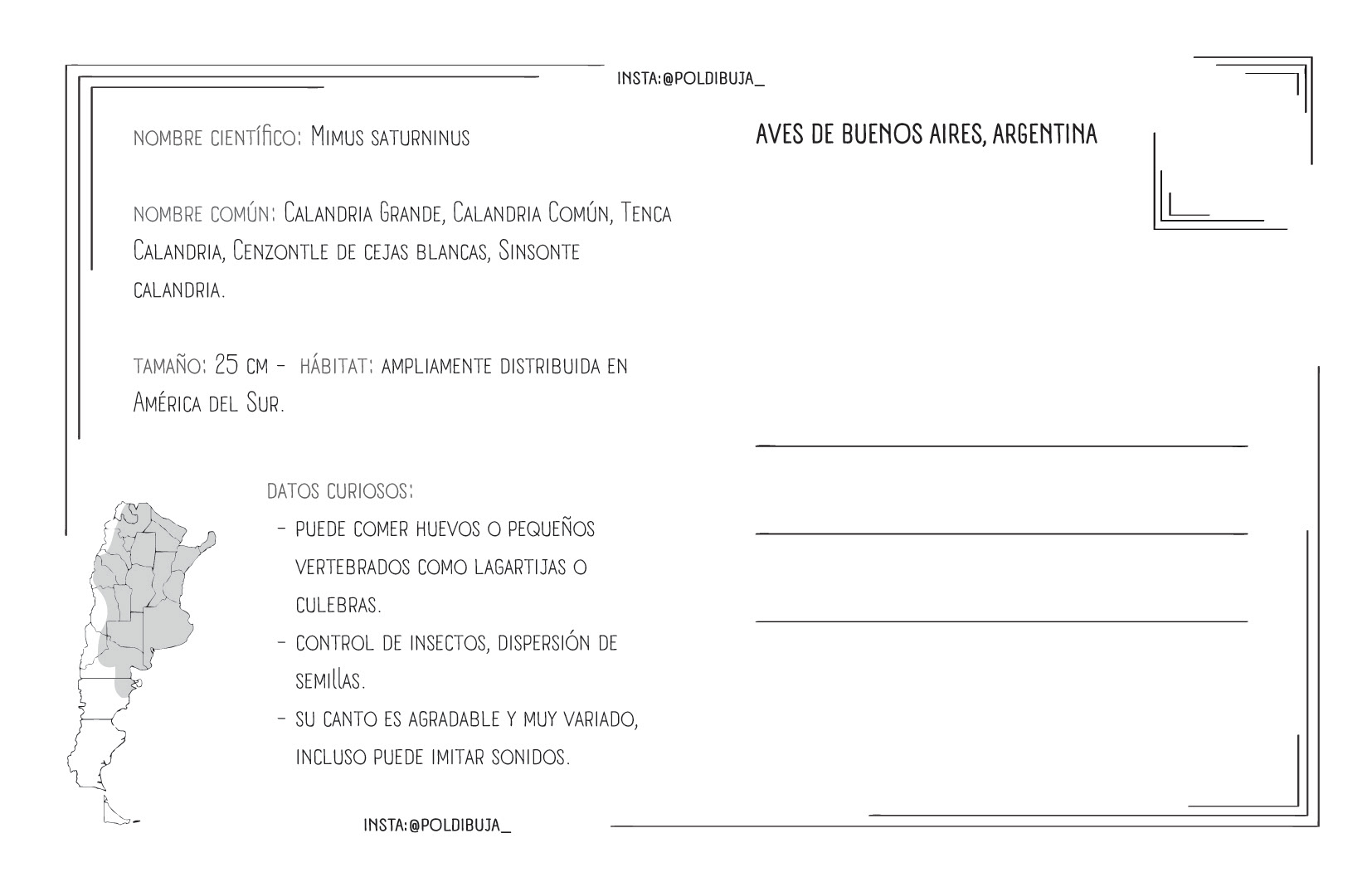
Ejemplo de dorso de postal con información sobre el ave y dónde puede encontrárselo en Argentina. /Example of a postcard back with information about the bird and where it can be found in Argentina.